



1. Introduction: The Missing Object Mystery
If you are a backend software engineer working within the Java ecosystem, you have almost certainly encountered this incredibly frustrating scenario: You design a custom class, instantiate an object, and carefully place it into a HashMap or HashSet. Later in your application's lifecycle, you create an identical object with the exact same internal data to retrieve your stored value. You call map.get(myObject), expecting a seamless retrieval. Instead, the database returns null.
You double-check the database, you verify the memory states, and you confirm that the data inside both objects is a perfect match. So, why did the HashMap fail to find your object?
For many junior developers, this is the exact moment they learn about the unbreakable contract between the equals() and hashCode() methods in Java. They quickly discover that their IDE or a library like Lombok can automatically generate a hashCode() method for them. Problem solved, right?
While relying on automated code generation will make your application function, a true senior engineer does not settle for a surface-level fix. If you open the source code generated by your IDE, or if you dive into the internal implementation of java.lang.String, you will consistently find a peculiar mathematical pattern: the variables are continuously multiplied by the seemingly random integer 31.
Why 31? Why not 10? Why not an even number like 32, or a larger prime number like 97?
In this comprehensive guide, we will dive deep into the computer science principles governing Java's memory structures. We will explore why implementing a custom hashCode is a non-negotiable architectural requirement, how hash collisions degrade system performance, and the fascinating mathematical and hardware-level optimizations that make the number 31 the undisputed king of Java hashing algorithms.
2. The Core Contract: equals() and hashCode()
To understand why we must manually implement a hash code, we must first understand how Java evaluates object equality.
By default, when you instantiate a new object in Java, it inherits the equals() and hashCode() methods from the ultimate parent class, java.lang.Object. The default implementation of equals() uses strict physical equality, also known as reference equality. It simply checks if two object variables point to the exact same physical memory address in the JVM heap space.
Similarly, the default hashCode() method (often referred to as the identity hash code) generates a unique integer based on the object's physical memory address.
When you override the equals() method to implement logical equality (e.g., stating that two User objects are equal if their email fields are the same, regardless of their memory address), you completely break the fundamental contract of Java collections if you fail to also override hashCode().
The official Java API documentation dictates a strict mathematical contract:
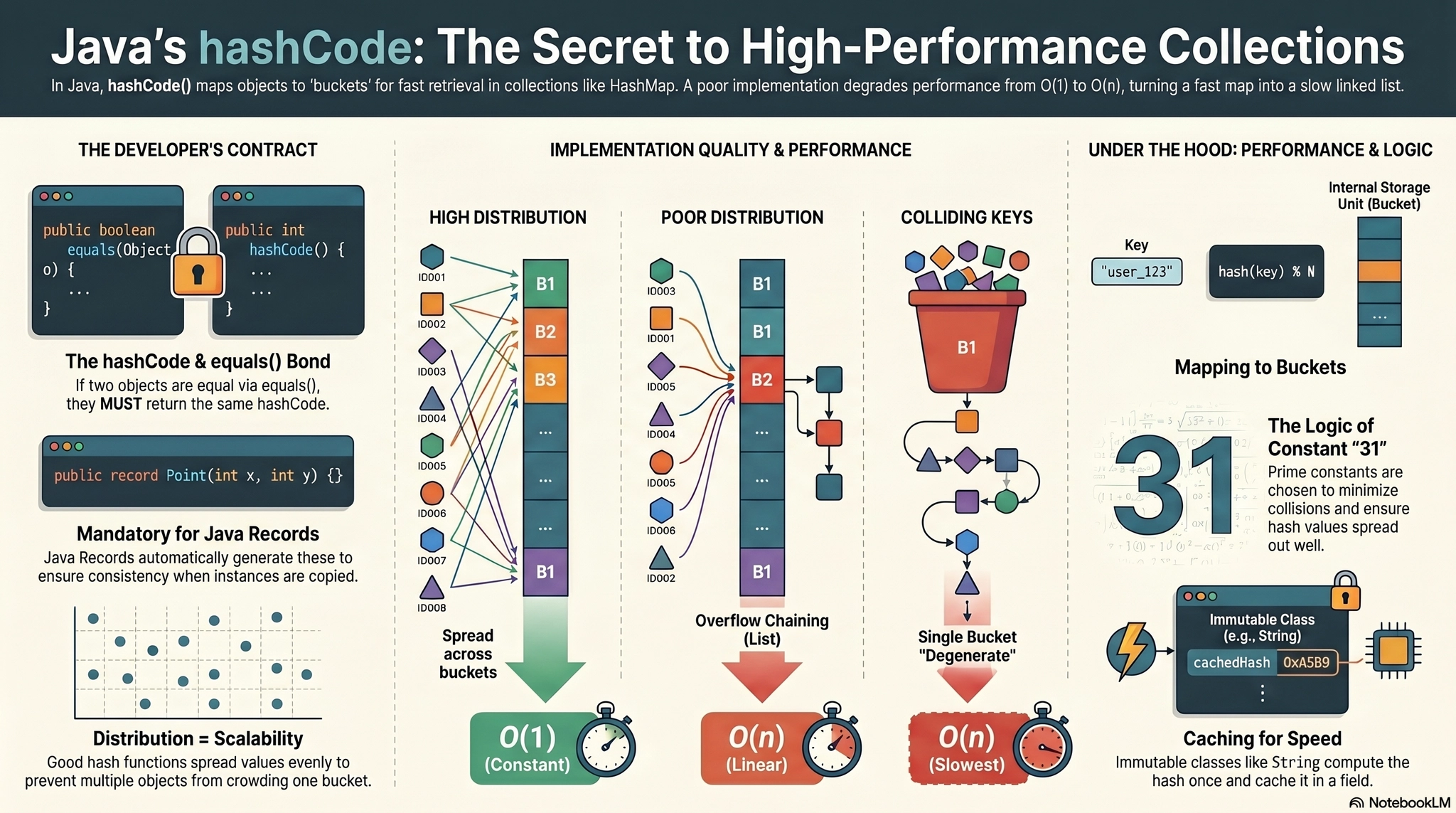
If two objects are equal according to the `equals(Object)` method, then calling the `hashCode()` method on each of the two objects must produce the exact same integer result.
If you violate this rule, hash-based collections such as HashMap, HashSet, and ConcurrentHashMap will fundamentally malfunction. To understand why this malfunction occurs, we must look inside the architecture of the HashMap.
3. Inside the HashMap: The O(1) Memory Architecture
Why do we use a HashMap instead of a standard ArrayList or LinkedList? The answer is algorithmic time complexity. Searching through an array or a linked list requires linear time, denoted mathematically as . If you have one million users, finding a specific user requires checking up to one million records.
A HashMap solves this by offering constant time complexity, or . It achieves this miraculous performance through a mechanism known as hashing.
Under the hood, a HashMap is simply an array of contiguous memory slots, usually referred to as "buckets." When you execute map.put(key, value), the JVM does not append the data to the end of the array. Instead, it performs a highly optimized mathematical sequence:
1.
Hash Generation: The JVM calls the hashCode() method on your key object, generating a 32-bit integer.
2.
Bitwise Hashing: The HashMap applies an internal bitwise XOR operation (hash ^ (hash >>> 16)) to spread the higher bits of the hash code to the lower bits, increasing randomness and entropy.
3.
Index Calculation: The JVM determines the exact bucket array index by applying a bitwise AND operator against the array's capacity: index = (capacity - 1) & hash.
Because the index is calculated mathematically directly from the object's data, the HashMap can instantly jump to the exact memory address where the object resides. This is why retrieval is .
However, if two logically equal objects return different hash codes (because you forgot to override the hashCode() method), the HashMap will calculate two completely different memory indices. The map will place the second object in the wrong bucket, and when you attempt to retrieve it later, the map will look in an empty bucket and incorrectly return null.
4. The Threat of Hash Collisions and Degradation
If the goal of a hash code is to instantly assign an object to a bucket, a critical computer science problem arises: the Pigeonhole Principle.
A Java hashCode() returns a standard 32-bit signed integer. This means there are exactly , or roughly 4.2 billion, possible unique hash codes. While 4.2 billion seems like a massive number, the number of possible objects you can create (like varying string combinations) is mathematically infinite.
According to the Pigeonhole Principle, if you attempt to place an infinite number of items into a finite number of buckets, eventually, two entirely different items must share the exact same bucket. When two unequal objects generate the exact same hash code (or map to the same array index), it is called a Hash Collision.
The Performance Degradation Penalty
What happens when a collision occurs in a Java HashMap? The system does not crash, nor does it overwrite the existing data. Instead, it implements a fallback mechanism called Separate Chaining.
If a HashMap attempts to place an object into a bucket that is already occupied by a different object, it creates a Linked List inside that single bucket. The new object is simply attached to the end of the chain.
While this prevents data loss, it destroys the performance optimization. If thousands of objects collide and fall into the same bucket, retrieving an item requires the JVM to traverse a massive Linked List one by one, degrading the system performance to . In a high-throughput backend environment, traversing long linked lists during every database lookup will exhaust CPU cycles and cripple your server's scalability.
(Note: Recognizing this vulnerability, the architects of Java 8 introduced a brilliant optimization via JEP 180. If a single bucket accumulates more than 8 collisions, the `HashMap` dynamically transforms the Linked List into a balanced Red-Black Tree. This limits the worst-case performance degradation from linear $O(n)$ to logarithmic $O(\log n)$. Nonetheless, preventing collisions in the first place remains the highest priority).
This brings us to the ultimate goal of the hashCode() method: To distribute data as uniformly and randomly as possible across the entire 32-bit integer space, thereby minimizing the probability of hash collisions.
5. The Magic Number 31: A Mathematical Deep Dive
When developers implement a custom hashCode(), or when they rely on the java.util.Objects.hash() utility, the internal implementation almost universally iterates through the object's fields, continuously multiplying the accumulated hash by the number 31.
For example, the official implementation of java.lang.String.hashCode() utilizes the following mathematical polynomial formula:
Where is the ASCII/Unicode character value at index , and is the length of the string.
But why 31? Why did the creators of Java select this specific integer to multiply our data? The answer lies at the intersection of pure mathematics and low-level hardware architecture.
The Requirement for an Odd Number
When designing a hashing algorithm, the multiplier must absolutely be an odd number. If you were to choose an even number, such as 32 or 10, you would introduce catastrophic data loss.
In binary arithmetic, multiplying any value by an even number like 2 (or any power of 2) is mathematically identical to performing a Bitwise Left Shift (<<).
If you continually multiply by even numbers, the binary bits of your hash code are rapidly shifted to the left. Because a Java integer has a strict, finite boundary of 32 bits, the topmost bits are completely pushed out of the memory register and permanently deleted. Meanwhile, the bottom bits are continuously backfilled with artificial zeros.
This constant shifting and zero-filling destroys the entropy (the mathematical randomness) of the hash code. If the randomness is destroyed, different objects will begin generating the exact same hash codes, triggering a massive wave of hash collisions and severely degrading the HashMap performance. By utilizing an odd number, the algorithm preserves the bit-level entropy and ensures a healthy, uniform distribution of data.
The Power of Prime Numbers
Beyond being odd, 31 is a Prime Number.
In computer science, prime numbers possess unique mathematical properties when used in modulo arithmetic and polynomial accumulation. Because prime numbers are only divisible by 1 and themselves, they drastically reduce the likelihood of creating repeating cyclic patterns when multiplied against highly structured, sequential data (such as strings that share similar prefixes like user_1, user_2, user_3).
If you use a non-prime odd number (a composite number like 15 or 27), structured data inputs might align with the common denominators of the composite number, leading to clustered hash distributions. Prime numbers act as a mathematical blender, forcefully scattering the resulting integers across the entire 4.2 billion possible bucket indices.
6. The Hardware Optimization: Why Not 37 or 41?
At this point, we have established that the multiplier must be an odd prime number. But there are infinitely many odd primes. Why didn't the Java architects choose 37, 41, or 73?
The selection of 31 is widely attributed to Joshua Bloch, the renowned author of Effective Java and a primary architect of the Java Collections Framework. The choice was not entirely based on pure mathematics, but rather on physical CPU hardware optimization.
In the early days of computing, physical multiplication (*) was one of the most expensive and slowest operations a CPU could perform. A standard Arithmetic Logic Unit (ALU) required multiple clock cycles to execute a single multiplication instruction. In contrast, Bitwise Shift operations and Subtraction operations are executed directly at the silicon level, typically completing in a single, lightning-fast CPU clock cycle.
The number 31 has an incredibly special binary relationship with the number 32 ().
Because 31 is exactly one less than a perfect power of two, the mathematical operation 31 * i can be perfectly translated into a bitwise shift and a subtraction:
$
Modern Just-In-Time (JIT) compilers and CPU architectures are exceptionally intelligent. When the Java Virtual Machine encounters a multiplication by 31, it automatically strips out the heavy, slow multiplication instruction and replaces it with (i << 5) - i.
By choosing 31, Java guarantees an incredibly robust, prime-number-based data distribution while simultaneously guaranteeing elite, single-cycle hardware execution speed. If they had chosen 37, this elegant bitwise optimization would be mathematically impossible, and hashing millions of objects would have been noticeably slower on legacy hardware systems.
7. Crafting the Perfect Custom hashCode()
Now that you possess a deep understanding of the mathematical and architectural principles behind Java hashing, you must apply these concepts to your enterprise backend code.
When you create a Domain-Driven Design (DDD) entity, a Data Transfer Object (DTO), or a Value Object, you must ensure that your hashCode correctly implements the prime multiplier pattern.
The Modern Approach: java.util.Objects
Since the release of Java 7, developers no longer need to write manual polynomial loops. The java.util.Objects class provides a highly optimized, variable-argument hashing utility that perfectly implements the 31 multiplier internally.
import java.util.Objects;
public class UserProfile {
private final String email;
private final String username;
private final int age;
public UserProfile(String email, String username, int age) {
this.email = email;
this.username = username;
this.age = age;
}
@Override
public boolean equals(Object o) {
if (this == o) return true;
if (o == null || getClass() != o.getClass()) return false;
UserProfile that = (UserProfile) o;
// Logical equality is defined by these three fields
return age == that.age &&
Objects.equals(email, that.email) &&
Objects.equals(username, that.username);
}
@Override
public int hashCode() {
// Automatically applies the 31 multiplier algorithm
return Objects.hash(email, username, age);
}
}
Java
복사
Unveiling the Internal Mechanism
If you were to look directly into the JDK source code for Arrays.hashCode(Object a[])—which Objects.hash() calls internally—you would witness the exact computer science principles we have discussed in action:
// Inside the internal JDK implementation
public static int hashCode(Object a[]) {
if (a == null)
return 0;
int result = 1;
for (Object element : a)
// The magic odd prime multiplier 31 is applied here
result = 31 * result + (element == null ? 0 : element.hashCode());
return result;
}
Java
복사
Notice how the result integer acts as an accumulator. As the loop iterates through your object's internal fields, the previous state is multiplied by 31 and shifted left, absorbing the entropy of the next field. This ensures that the order of the fields matters. An object with data [A, B] will generate a wildly different hash code than an object with data [B, A], further preventing Hash Collisions and ensuring database retrieval.
8. Conclusion and Summary
The design of a high-performance backend application extends far beyond simple API routing and database queries. True system reliability and scalability rely heavily on the fundamental computer science algorithms dictating how memory is allocated and retrieved.
In the Java ecosystem, the HashMap is the backbone of almost all fast-access data processing. However, its speed is an illusion that only holds true if developers respect the rigorous contract between equals() and hashCode(). Failing to implement a custom hash code leads to broken retrievals, lost data, and severe memory leaks.
When constructing this required hashCode, the number 31 is not arbitrary. It is a masterpiece of software engineering compromises.
1.
It is odd, preventing the disastrous bitwise zero-filling that destroys entropy.
2.
It is prime, scattering structured data aggressively across the 32-bit integer space to avoid HashMap bucket collisions.
3.
It is exactly $2^5 - 1$, allowing modern compilers and CPUs to execute the operation using lightning-fast bitwise shifts (i << 5) - i instead of computationally expensive multiplication.
By understanding the mathematical brilliance hidden within the JVM, you transcend the level of a framework-dependent coder. You become a software architect capable of analyzing bottlenecks, respecting memory constraints, and building enterprise Java systems that perform flawlessly under the heaviest of operational loads.
References
[1] Core Technologies-all — 4.3.6. Methods 4.3.7. Operators Relational Operators Logical Operators Mathematical Operators The Assignment Operator 4.3.8. Types 4.3.9. Constructors 4.3.10. Variables The #this and #root Variables 4.3.11. Functions 4.3.12. Bean References 4.3.13. Ternary Operator (If-Then-Else) 4.3.14. The Elvis…
[2] designing-data-intensive-applications — hardware faults, 7 hash indexes, 72-75 broadcast hash joins, 409 partitioned hash joins, 409 hash partitioning, 203-205, 217 consistent hashing, 204 problems with hash mod N, 210 range queries, 204 suitable hash functions, 203 with fixed number of partitions, 210 HAWQ (database), 428 HBase (database…
[3] designing-data-intensive-applications — [5] Ikai Lan: “App Engine Datastore Tip: Monotonically Increasing Values Are Bad,” ikaisays.com, January 25, 2011. [6] Martin Kleppmann: “Java’s hashCode Is Not Safe for Distributed Systems,” mar‐ tin.kleppmann.com, June 18, 2012. [7] David Karger, Eric Lehman, Tom Leighton, et al.: “Consistent Hash…
