



Introduction to the Mechanics of String Hashing
If you have spent any significant amount of time developing enterprise software in Java, you have undoubtedly relied on the String class as a primary key in collections like HashMap or HashSet. Developers often take the performance of these data structures for granted, assuming that retrieving a value by its string key is always an instantaneous, constant-time operation. However, the reality of how the Java Virtual Machine (JVM) computes and handles the hash values for strings is far more complex and mathematically nuanced than it appears on the surface.
Understanding the precise implementation of the String class's hash function is not merely an academic exercise. It is a critical architectural concept that directly impacts application performance, memory visibility in multithreaded environments, and even the security of your backend systems against targeted denial-of-service attacks. When a developer ignores the underlying mechanics of string hashing, they risk introducing severe performance bottlenecks when their applications scale to handle millions of records.
In this comprehensive guide, we will conduct a deep dive into the internal implementation of the Java String hash function. We will explore the mathematical foundations of polynomial hashing, analyze the brilliant but risky concurrency optimizations made by the JVM engineers, and uncover the fatal mathematical flaws that can lead to catastrophic hash collisions. By examining these core concepts, you will gain the advanced knowledge required to architect highly scalable, robust, and performant data-intensive applications.
The Mathematical Foundation of Polynomial Hashing
To understand how Java converts a sequence of characters into a single integer, we must first examine the concept of string hashing. String hashing is a programmatic technique that allows systems to efficiently check whether two strings are equal by comparing their numerical hash values instead of comparing them character by character [1].
A hash value of a string is a numerical representation calculated from the individual characters that make up the text. If two strings are exactly the same, their calculated hash values will be identical, which allows data structures to quickly categorize and retrieve them [1]. The standard algorithmic approach to implement string hashing is known as polynomial hashing.
In polynomial hashing, the hash value of a string s of length n is calculated using a specific algebraic formula: [3].
In this formula, the characters are interpreted as their corresponding integer character codes (such as ASCII or Unicode values), while and are pre-chosen mathematical constants [3].
The Java programming language implements a highly specific variation of this polynomial hashing formula for its String class. If you look at the source code of java.lang.String, the documentation specifies that the hash code is computed as:
s*31^(n-1) + s[2]*31^(n-2) + ... + s[n-1]
In this implementation, the constant is chosen to be . The constant is implicitly defined by the architectural limitations of the Java int primitive data type. Because a Java int is a 32-bit signed integer, any mathematical operation that exceeds the maximum capacity of 32 bits will automatically overflow. This automatic integer overflow acts exactly like a modulo operation where .
Why did the creators of Java select the number 31 as the constant multiplier ? The choice of 31 is not arbitrary; it is rooted in both mathematics and hardware optimization. First, 31 is an odd prime number. Using prime numbers in hash functions is a long-standing mathematical best practice because it minimizes the loss of information when multiplying numbers that frequently result in integer overflows. If an even number were used as the multiplier, multiplying it repeatedly would act like a bitwise left shift, rapidly filling the lower bits with zeros and destroying the entropy (randomness) of the character data.
Secondly, 31 offers a unique hardware-level optimization. Modern compilers and processors can replace the relatively expensive multiplication operation with a much faster bitwise shift and subtraction operation. Mathematically, 31 * i is perfectly equivalent to (i << 5) - i. The Java Virtual Machine leverages this optimization internally, allowing string hash calculations to execute with blazing speed across massive datasets.
Immutability, Lazy Evaluation, and the Java Memory Model
One of the most fascinating architectural decisions in the Java String class is how it handles the execution and storage of the hash code. Strings in Java are strictly immutable; once a string object is created, its internal state and character array can never be modified [4]. This immutability provides massive advantages for safe sharing across multiple concurrent threads, but it also provides a unique opportunity for performance optimization.
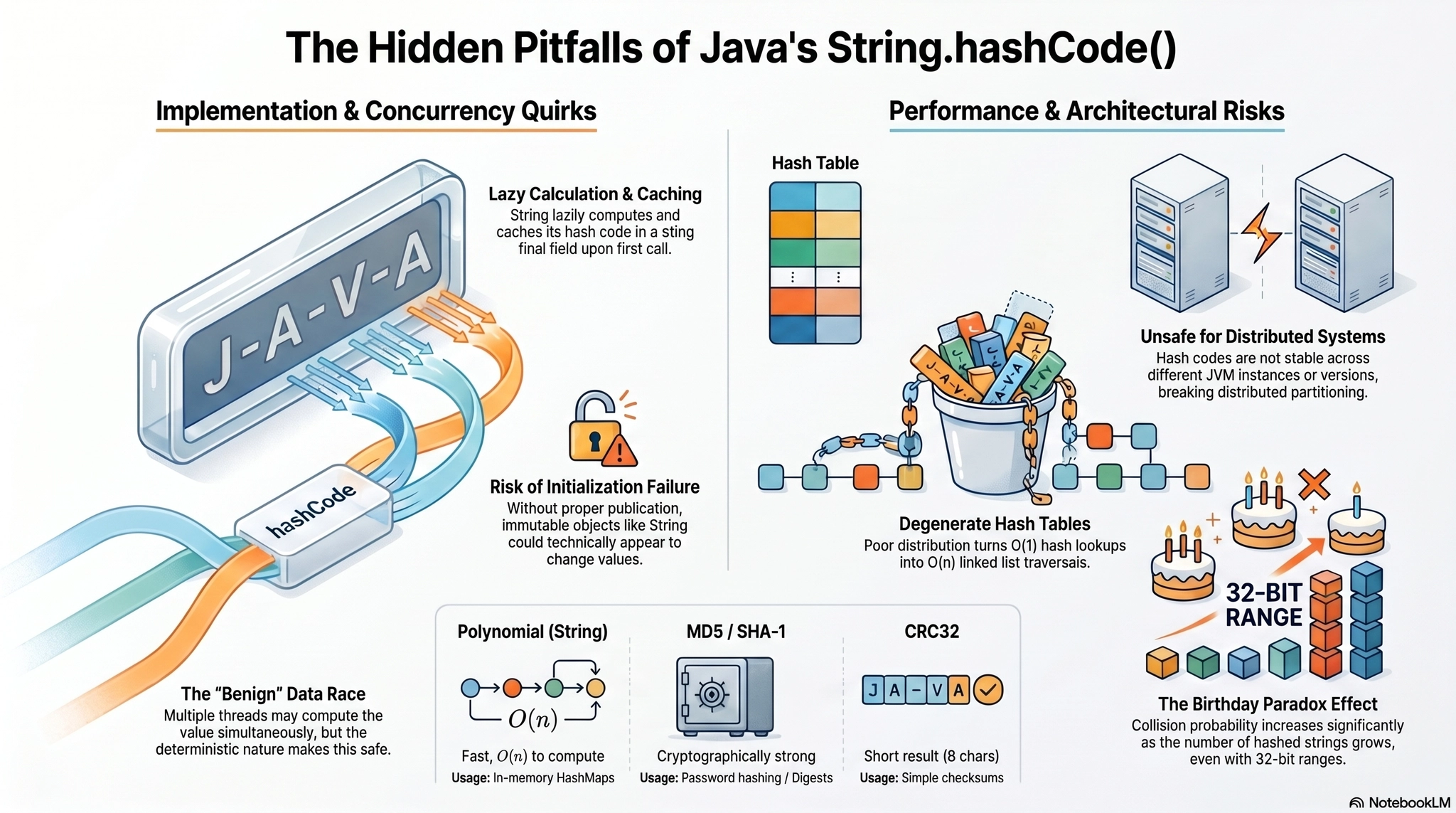
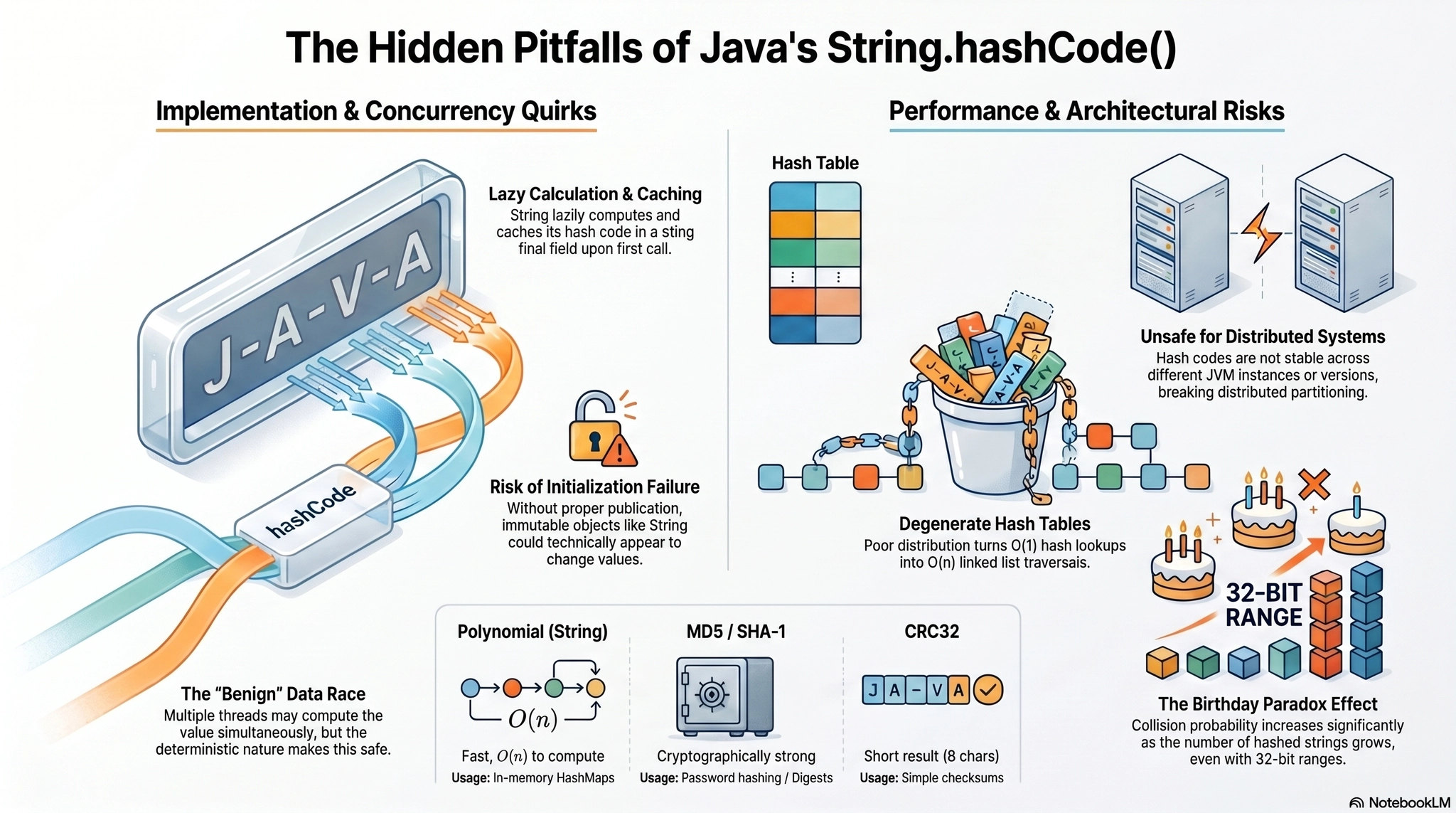
Because a string cannot change, its hash code will never change. Therefore, there is no need to recalculate the polynomial formula every single time the hashCode() method is called. Instead, the Java String class lazily computes the hash code the very first time the method is invoked and then caches the result in a private integer field (typically named hash) [4]. Subsequent calls to hashCode() simply return this cached integer, reducing the time complexity from to .
However, this caching mechanism introduces a fascinating dilemma within the Java Memory Model (JMM). The hash field used to store the cached integer is not declared as a final field. For initialization safety to hold perfectly without explicit synchronization, all fields of an immutable object must be final [4]. Because the hash field is non-final, it is technically possible for multiple threads to access the string concurrently and attempt to compute the hash code simultaneously.
This scenario creates a data race. If Thread A and Thread B both call hashCode() on a fresh string simultaneously, they might both see that the hash field is currently 0. Consequently, both threads will independently execute the polynomial hashing loop and attempt to write the result back to the hash field.
Why is this acceptable in a secure enterprise platform like Java? This specific scenario is known as a "benign data race." It relies on delicate reasoning about the Java Memory Model. The data race is considered benign because the computation of the hash code is derived deterministically entirely from the immutable character array [4]. No matter how many threads calculate the hash code simultaneously, they will all arrive at the exact same mathematical integer. One thread might overwrite the result of another thread, but the value being written is identical. The JVM engineers deliberately allowed this benign data race to avoid the severe performance overhead that would result from placing a synchronized lock block inside one of the most frequently called methods in the entire Java ecosystem.
This brilliant hack relies heavily on the guarantee of initialization safety provided by the JVM. Initialization safety guarantees that for properly constructed objects, all threads will reliably see the correct values of final fields that were set during the object's construction, regardless of how the object reference is published [5]. Because the underlying character array is final, all threads are guaranteed to see the correct characters when they compute the hash, ensuring that the deterministic mathematical output is always correct [5, 6].
The Fatal Flaws: Hash Collisions and Modulo Arithmetic
While the implementation of Java's string hashing is highly optimized for raw execution speed, it suffers from significant mathematical vulnerabilities. An evident risk when comparing hash values is a collision, which occurs when two entirely different strings generate the exact same integer hash value [7]. When an algorithm relies purely on hash values, a collision forces the system to fall back on full character-by-character string comparisons, which destroys the performance benefits of hashing [7].
Collisions are an absolute mathematical certainty. There is an infinite number of possible strings, but a 32-bit integer can only represent unique values. By the Pigeonhole Principle, if you hash more strings than the maximum capacity of an integer, collisions must occur [8].
However, because of the Birthday Paradox, severe collisions happen much faster than most developers anticipate. The Birthday Paradox dictates that when all hash values are compared with each other, the probability that some two hash values are equal grows incredibly fast, even with a small sample size [9]. For a 32-bit hash function like Java's, the probability of a collision reaches 1% with as few as 93,000 distinct string values [10]. If your application loads a dictionary of a few hundred thousand words into a hash map, you are guaranteed to experience hundreds of collisions [10].
The situation is worsened by the implicit modulo operation of the 32-bit integer overflow. As previously noted, the polynomial hash uses a multiplier of and an implicit modulo of . Mathematical research has proven that using constant modulo boundaries of the form is computationally fast but algorithmically weak. It is a poor mathematical choice because it allows malicious actors to easily reverse-engineer the formula and construct specific input strings that will consistently and predictably generate identical hash codes [11]. Operations strictly calculated modulo discard the high-order bits of the entropy during every overflow, heavily concentrating the final results into predictable patterns [11].
Security Vulnerabilities: Algorithmic Complexity Attacks
The predictability of Java's modulo polynomial hash creates a critical vulnerability known as an Algorithmic Complexity Attack, or a Hash Denial-of-Service (HashDoS) attack.
In a standard Java HashMap, elements are stored in an array of "buckets." The bucket index is determined by the hash code of the string key. Under normal, well-distributed conditions, a hash map provides time complexity for retrieving or inserting a value. However, if multiple strings produce the exact same hash code, they are placed into the exact same bucket. Historically, Java handled this by linking the elements together in a simple linked list. If an attacker sends 100,000 strings that all mathematically collide into the same bucket, the hash map degrades from a highly efficient structure into an excruciatingly slow linked list.
Because the Java string hash algorithm is universally known and deterministically vulnerable to the modulo flaw [11], an attacker can generate millions of colliding strings offline. For example, the strings "Aa" and "BB" have the exact same hash code in Java. By combining these substrings into longer permutations (e.g., "AaAa", "AaBB", "BBAa", "BBBB"), an attacker can generate an exponential number of strings that all share the exact same hash code.
If the attacker submits these colliding strings as part of a large JSON payload, an HTTP form submission, or URL parameters, the backend Java server will attempt to insert them into a HashMap. The server's CPU will spike to 100% as it struggles to traverse the massive linked lists for every single insertion. This vulnerability can completely freeze enterprise servers, resulting in a devastating Denial of Service without requiring massive network bandwidth.
(Note: In modern Java versions, starting from Java 8, the JVM attempts to mitigate this vulnerability by converting hash buckets that contain too many collisions from linked lists into Red-Black Trees. This improves the worst-case degradation from $O(n)$ to $O(\log n)$. While this optimization significantly lessens the impact of a HashDoS attack, it does not fix the underlying mathematical weakness of the string hash function itself.)
Moving Beyond Basic Hashing: Modern Alternatives
If the built-in string hashing is fundamentally flawed by collisions and modulo predictability, how should engineers architect systems that require strict data integrity and massive scale?
When the integrity of the data comparison is absolutely critical, and collisions cannot be tolerated under any circumstances, developers must abandon polynomial hashing and utilize Cryptographic Hash Functions. A cryptographic hash function is a specially designed algorithm that produces a large, highly randomized digest (or fingerprint) of the input string [12].
Cryptographic hashes are designed with three mandatory mathematical properties [12, 13]:
1.
Preimage resistance: Given the final hash value, it must be computationally impossible to figure out the original string.
2.
Second preimage resistance: Given one string, it must be impossible to find a different string that generates the same hash value.
3.
Collision resistance: It must be exceptionally difficult to find any two random strings that generate the same hash value.
Algorithms like the Message Digest Algorithm 5 (MD5) generate a 128-bit digest, while Secure Hash Algorithm 1 (SHA-1) produces a 160-bit digest [13]. The SHA-2 family provides even stronger guarantees with digests up to 512 bits [13]. The massive bit space of these algorithms entirely defeats the Birthday Paradox for any realistic application workload. However, cryptographic hashes are exceptionally CPU-intensive and slow to calculate.
For scenarios where you simply need a fast, non-cryptographic hash for massive hash tables without the vulnerabilities, modern data engineering relies on advanced hashing algorithms like MurmurHash, SipHash, or FNV64. The FNV64 function, for example, is a 64-bit algorithm that is incredibly fast to compute and dramatically less prone to collisions than traditional 32-bit functions like CRC32 or Java's built-in string hash [14]. By utilizing 64-bit non-cryptographic hashes, big data processing frameworks (like Apache Spark or Hadoop) can distribute keys evenly across distributed clusters without suffering from the localized hot spots caused by algorithmic collisions.
Summary and Conclusion
The architecture of the Java String class's hashCode() function represents a masterclass in software engineering trade-offs. The designers required an algorithm that was universally applicable, extremely fast to execute, and memory efficient.
By implementing a polynomial hashing formula with a prime multiplier of 31, the JVM effortlessly optimizes multiplications into rapid bitwise shifts. By aggressively leveraging the immutability of string objects, the JVM caches the integer result to provide constant-time lookup performance, relying on a deeply technical "benign data race" within the Java Memory Model [4, 5].
However, these extreme performance optimizations come at the cost of mathematical purity. The restriction to a 32-bit integer combined with the implicit modulo arithmetic makes the Java string hash highly susceptible to the Birthday Paradox and deterministic collision generation [10, 11]. As we have explored, these vulnerabilities can degrade application performance and expose servers to algorithmic complexity attacks.
As software architects, understanding the intricate details of how core platform libraries function is non-negotiable. While the built-in string hash is perfectly adequate for standard application state management, recognizing its inherent limitations empowers you to deploy superior alternatives—such as cryptographic SHA-256 for secure verification [13], or 64-bit FNV hashing for massive distributed data partitioning [14]—precisely when the scale and security of your platform demand it. By applying these rigorous principles, you ensure that your data-intensive applications remain resilient, performant, and secure under the heaviest of workloads.
References
[1] book — String hashing String hashing is a technique that allows us to efficiently check whether two strings are equal1. The idea in string hashing is to compare hash values of strings instead of their individual characters. Calculating hash values A hash value of a string is a number that is calculated fro…
[2] Core Technologies-all — A class that implements the org.springframework.beans.factory.support.MethodReplacer interface provides the new method definition, as the following example shows: Java Kotlin public abstract class CommandManager { public Object process(Object commandState) { MyCommand command = createC…
[3] book — (s[0]An−1 +s[1]An−2 +·· ·+s[n−1]A0) mod B, where s[0], s[1], . . . , s[n−1] are interpreted as the codes of the characters of s, and A and B are pre-chosen constants. For example, the codes of the characters of ALLEY are: A L L E Y 65 76 76 69 89 Thus, if A = 3 and B = 97, the hash value of ALLEY is…
[4] Java Concurrency in Practice — @Immutable public final class ThreeStooges { private final Set<String> stooges = new HashSet<String>(); public ThreeStooges() { stooges.add("Moe"); stooges.add("Larry"); stooges.add("Curly"); } public boolean isStooge(String name) { return stooges.contains(name); } } Listing 3.11. Immutable class bu…
[5] Java Concurrency in Practice — Without initialization safety, supposedly immutable objects like String can appear to change their value if synchronization is not used by both the publishing and consuming threads. The security architecture relies on the immutability of String; the lack of initialization safety could create securit…
[6] Java Concurrency in Practice — 6. This applies only to objects that are reachable only through final fields of the object under con-struction. 350 Chapter 16. The Java Memory Model For objects with final fields, initialization safety prohibits reordering any part of construction with the initial load of a reference to that object…
[7] book — By combining hashing and binary search, it is also possible to find out the lexicographic order of two strings in logarithmic time. This can be done by calculating the length of the common prefix of the strings using binary search. Once we know the length of the common prefix, we can just check the …
[8] book — Collisions are always possible, because the number of different strings is larger than the number of different hash values. However, the probability of a collision is small if the constants A and B are carefully chosen. A usual way is to choose random constants near 109, for example as follows: A = …
[9] book — The phenomenon in scenario 3 is known as the birthday paradox: if there are n people in a room, the probability that some two people have the same birthday is large even if n is quite small. In hashing, correspondingly, when all hash values are compared with each other, the probability that some two…
[10] O'Reilly.High.Performance.MySQL.3rd.Edition.Mar.2012 (1) — mysql> SELECT id FROM url WHERE url_crc=CRC32("http://www.mysql.com"); The probability of a hash collision grows much faster than you might think, due to the so-called Birthday Paradox. CRC32() returns a 32-bit integer value, so the probability of a collision reaches 1% with as few as 93,000 values.…
[11] book — Some people use constants B = 232 and B = 264, which is convenient, because operations with 32 and 64 bit integers are calculated modulo 232 and 264. How-ever, this is not a good choice, because it is possible to construct inputs that always generate collisions when constants of the form 2x are used…
[12] tcpip-illustrated-volume-1-2nd-edition — A checksum or FCS can be used to verify message integrity against an adver-sary like Mallory if properly constructed using special functions. Such functions are called cryptographic hash functions and often resemble portions of encryption algorithms. The output of a cryptographic hash function H, wh…
[13] tcpip-illustrated-volume-1-2nd-edition — Second preimage resistance: Given H(M1), it should be difficult to deter-mine an M2 ≠ M1 such that H(M1) = H(M2). Collision resistance: It should be difficult to find any pair M1, M2 where H(M1) = H(M2) when M2 ≠ M1. If a hash function has all of these properties, then if two messages have the same …
[14] O'Reilly.High.Performance.MySQL.3rd.Edition.Mar.2012 (1) — To avoid problems with collisions, you must specify both conditions in the WHERE clause. If collisions aren’t a problem—for example, because you’re doing statistical queries and you don’t need exact results—you can simplify, and gain some efficiency, by using only the CRC32() value in the WHERE clau…
