



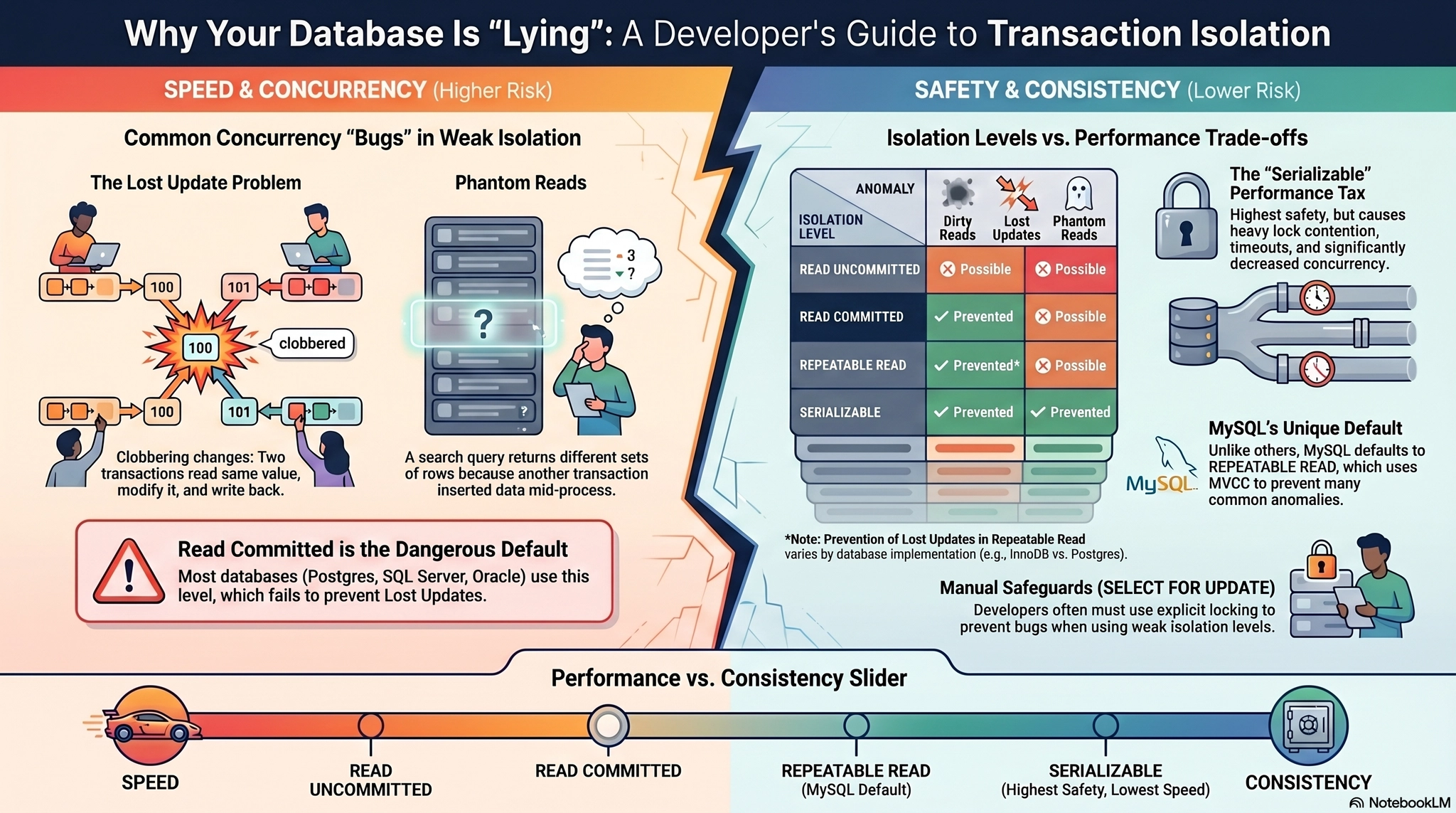
Introduction: The Illusion of Database Safety
When software engineers architect data-intensive applications, they implicitly rely on the underlying database system to handle the chaotic nature of concurrent user traffic. We write our business logic, execute our unit tests in isolated local environments, and deploy to production, assuming that the database's ACID properties (Atomicity, Consistency, Isolation, Durability) will magically protect our data [1]. However, when millions of users interact with the system simultaneously, race conditions inevitably emerge, leading to corrupted financial records, double-booked reservations, and inconsistent application states.
The root cause of these catastrophic failures usually stems from a fundamental misunderstanding of database transaction isolation levels. In an ideal world, every database would operate in a strictly sequential manner, executing one transaction entirely before beginning the next. However, executing transactions serially is computationally disastrous for scalability and throughput. To maximize hardware utilization and reduce response times, modern database engines interleave the execution of multiple transactions.
To govern how these interleaved transactions interact, the SQL standard defines various isolation levels. Strikingly, the vast majority of popular relational databases—including PostgreSQL, Oracle, and SQL Server—do not default to the safest isolation level. Instead, they default to READ COMMITTED [2]. While READ COMMITTED prevents the most basic concurrency anomalies, it leaves the door wide open for highly destructive bugs. In this comprehensive engineering guide, we will dive deep into the mathematical and architectural realities of transaction isolation, reproduce the infamous Lost Update and Phantom Read anomalies, and uncover exactly why the seemingly perfect SERIALIZABLE isolation level is avoided by seasoned architects.
The Default Trap: Understanding READ COMMITTED and MVCC
To understand why bugs occur in modern databases, we must first understand how they manage concurrent access. Early database systems relied heavily on pessimistic locking: if a transaction wanted to read a row, it acquired a shared lock, preventing any other transaction from writing to that row until the read was finished. This caused massive performance bottlenecks because readers blocked writers, and writers blocked readers.
To resolve this, modern databases implemented Multi-Version Concurrency Control (MVCC) [3]. In an MVCC architecture, the database maintains multiple versions of a single row. When a transaction writes to a row, it does not overwrite the old data immediately; instead, it creates a new version of the row stamped with a transaction ID.
Under the READ COMMITTED isolation level, the database guarantees two things:
1.
No Dirty Reads: You will only read data that has been successfully committed by other transactions.
2.
No Dirty Writes: You will only overwrite data that has been successfully committed.
When a transaction in READ COMMITTED executes a SELECT statement, the MVCC engine simply looks at the snapshot of the database at the exact moment that specific query began, ignoring any uncommitted versions. This is incredibly fast and entirely lock-free for read operations. However, this snapshot behavior is precisely what causes the most common and dangerous concurrency anomaly: the Lost Update.
Reproducing the Lost Update Anomaly
The Lost Update anomaly occurs when two concurrent transactions read the same database row, calculate a new value based on the read value, and then write the new value back to the database. Because the two transactions are interleaved, the second write completely overwrites and destroys the first write, effectively "losing" the update.
This pattern is ubiquitous in software engineering. As documented by data systems experts, it occurs constantly in scenarios such as incrementing a counter, updating a financial account balance, or when two users edit a wiki page at the same time and save their changes by sending the entire page contents back to the server [4].
Let us directly reproduce this bug in a READ COMMITTED environment. Imagine a banking application where Alice and Bob share a joint account with a balance of 50, and Bob simultaneously deposits $20.
1.
Time T1: Transaction A (Alice) executes SELECT balance FROM accounts WHERE id = 1;. The MVCC engine returns $100.
2.
Time T2: Transaction B (Bob) executes SELECT balance FROM accounts WHERE id = 1;. The MVCC engine also returns $100.
3.
Time T3: Transaction A calculates the new balance (50 = 150`.
4.
Time T4: Transaction B calculates its new balance based on the value it read at T2 (20 = $120). It executes UPDATE accounts SET balance = 120 WHERE id = 1;. Transaction B commits.
The final balance in the database is $120. Alice's $50 deposit has vanished into the digital void. The database did not throw an error, and the application believes both transactions succeeded. The READ COMMITTED isolation level allowed this because Transaction B's read at T2 was a valid, committed value at that exact microsecond.
How to Prevent Lost Updates
Software engineers cannot rely on READ COMMITTED to handle read-modify-write cycles. To prevent Lost Updates without escalating the global database isolation level, developers must utilize explicit concurrency control mechanisms:
1. Atomic Write Operations:
Whenever possible, avoid pulling data into the application layer for calculation. Instead, force the database to perform the read and write in a single atomic operation:
UPDATE accounts SET balance = balance + 50 WHERE id = 1;
In most databases, this atomic instruction automatically acquires an exclusive lock on the row during the update, forcing concurrent updates to queue and execute sequentially.
2. Explicit Pessimistic Locking:
If the business logic is too complex for a single SQL atomic update, you must explicitly lock the rows during your initial SELECT using the FOR UPDATE clause [5].
SELECT balance FROM accounts WHERE id = 1 FOR UPDATE;
When Transaction A executes this, Transaction B's attempt to execute the same SELECT ... FOR UPDATE will be blocked by the database engine until Transaction A commits or rolls back.
3. Optimistic Concurrency Control (Compare-and-Swap):
Alternatively, developers can use a version column to detect concurrent modifications [6].
UPDATE accounts SET balance = 120, version = 2 WHERE id = 1 AND version = 1;
If Transaction A has already updated the row to version 2, Transaction B's query will affect 0 rows, allowing the application framework to detect the conflict, abort, and safely retry the transaction.
The Mechanics of Write Skew and Phantom Reads
If READ COMMITTED is so dangerous, why not just upgrade the database to REPEATABLE READ or utilize full Snapshot Isolation? While Snapshot Isolation ensures that a transaction sees a consistent snapshot of the database for its entire duration, it still falls victim to more insidious anomalies: Write Skew and Phantom Reads [7].
A Phantom Read occurs when a transaction executes a query that searches for a collection of rows matching a specific search condition, but another concurrent transaction inserts or deletes rows that match that exact condition.
Let us reproduce a Phantom Read within the context of a hospital's on-call shift management system. The business rule dictates that there must always be at least one doctor on call during a shift.
1.
Time T1: Transaction A (Doctor Alice) checks if she can take the day off. She executes:
SELECT COUNT(*) FROM on_call_shifts WHERE date = '2026-05-17';
The database returns 2 (Alice and Bob are both on call).
1.
Time T2: Transaction B (Doctor Bob) also wants the day off. He executes the exact same query:
SELECT COUNT(*) FROM on_call_shifts WHERE date = '2026-05-17';
The database returns 2.
1.
Time T3: Transaction A assumes it is safe to leave. Alice executes DELETE FROM on_call_shifts WHERE date = '2026-05-17' AND doctor = 'Alice'; and commits.
2.
Time T4: Transaction B makes the same assumption. Bob executes DELETE FROM on_call_shifts WHERE date = '2026-05-17' AND doctor = 'Bob'; and commits.
The result is a violation of the critical business rule: zero doctors are currently on call. This specific variation of a phantom read is known as Write Skew.
Why did explicit locking not save us here? If Alice had used SELECT ... FOR UPDATE, she would have locked the rows representing her and Bob. However, imagine a different scenario: a meeting room booking system where you cannot double-book a room.
Transaction A checks for overlapping bookings: SELECT * FROM bookings WHERE room = 101 AND time = '10:00'. It returns zero rows.
How can Transaction A lock a row that does not exist yet? It cannot. Therefore, Transaction B can freely execute an INSERT for room 101 at 10:00. Both transactions commit, and the room is double-booked. The "phantom" row appeared out of nowhere between the read and the write phases.
Why Engineers Avoid SERIALIZABLE Like the Plague
To achieve true, flawless data integrity and eliminate Phantom Reads, the SQL standard provides the SERIALIZABLE isolation level. Under SERIALIZABLE, the database guarantees that the final result of concurrent transactions will be identical to the result if those transactions had been executed one by one in a strictly sequential order.
If SERIALIZABLE is the only way to mathematically guarantee absolute correctness, why is it almost universally avoided by backend engineers and database administrators? The answer lies in the devastating performance overhead and the architectural mechanisms required to implement it.
To implement SERIALIZABLE isolation and prevent Phantom Reads, most traditional relational databases rely on a concurrency control protocol known as Two-Phase Locking (2PL) [8]. Two-Phase Locking enforces a brutally strict regime:
•
If Transaction A has read a row, Transaction B is strictly prohibited from writing to that row. Transaction B must wait until Transaction A completes.
•
If Transaction A has written to a row, Transaction B is strictly prohibited from reading or writing to that row until Transaction A completes.
In READ COMMITTED, readers do not block writers. Under SERIALIZABLE with 2PL, readers actively block writers, and writers actively block readers.
However, 2PL alone does not solve the Phantom Read problem, because standard locks only apply to existing rows. To prevent another transaction from inserting a new phantom row, the database engine must utilize Index-Range Locks, also known as Next-Key Locks in MySQL InnoDB [9].
When a transaction executes a query like SELECT * FROM bookings WHERE room = 101 AND time = '10:00', the database cannot just lock existing rows. It must place an index-range lock on the gap in the database index corresponding to room 101 at 10:00 [8]. If another transaction attempts to insert a new booking into that exact index gap, the database intercepts the operation at the B-Tree index level and suspends the inserting thread until the first transaction finishes.
The Catastrophic Impact on Scalability
The combination of Two-Phase Locking and Index-Range Locks introduces severe architectural penalties that destroy application scalability:
1.
Massive Lock Contention and Latency: In a highly concurrent system, transactions are constantly waiting for locks to be released. According to the Universal Scalability Law and Amdahl's Law, the maximum throughput of a concurrent system is strictly limited by the portion of the execution that must occur sequentially. By forcing index gaps and heavily read rows to be exclusively locked, SERIALIZABLE forces the CPU to sit idle while transactions queue up. A system that could process 10,000 queries per second under READ COMMITTED might degrade to 500 queries per second under SERIALIZABLE simply due to lock acquisition overhead and thread suspension.
2.
Exponential Increase in Deadlocks: Because readers are constantly placing shared locks on ranges of data, and writers are attempting to acquire exclusive locks on those same ranges, the probability of cyclic deadlocks skyrockets. When a deadlock occurs, the database has no choice but to forcefully abort and rollback one of the transactions. The application server must then catch the serialization failure exception and retry the entire transaction from scratch. Under heavy load, this creates a vicious cycle of retries, further clogging the database's connection pool and CPU resources.
3.
Loss of Predictable Performance: In MVCC systems using READ COMMITTED, read queries have highly predictable, stable latencies because they never wait for locks. Under 2PL SERIALIZABLE, a simple read query's response time is entirely unpredictable. If a massive batch update is currently modifying a table, a simple SELECT query might hang for several seconds waiting for the range lock to clear. This violates the core principles of building responsive, people-first applications.
(Note: It is worth mentioning that modern academic research has led to the development of Serializable Snapshot Isolation (SSI), adopted by PostgreSQL. SSI uses an optimistic approach: it allows transactions to proceed without blocking, but tracks read-write dependencies. Before committing, it mathematically checks if a serialization anomaly occurred. If it detects a Write Skew or Phantom, it aborts the transaction. While SSI avoids the blocking nightmare of 2PL, it still results in a massive number of transaction aborts under highly contented workloads, forcing the application layer to implement aggressive and complex retry logic [10].)
Conclusion: Architecting for Data Integrity
Navigating database concurrency is one of the most intellectually demanding challenges in software engineering. The READ COMMITTED isolation level, while universally adopted for its blazing speed and minimal lock contention, provides a dangerously thin veil of safety. It effortlessly allows Lost Updates to silently corrupt financial data and state transitions.
Conversely, the SERIALIZABLE isolation level mathematically guarantees flawless execution but demands a performance tax that modern, high-throughput cloud applications simply cannot afford to pay. The heavy reliance on Two-Phase Locking and Index-Range gap locks creates brutal bottlenecks and deadlocks that bring highly parallel server architectures to a grinding halt.
True database mastery requires engineers to operate in the gray area between these two extremes. Architects must deliberately leave the database at READ COMMITTED or REPEATABLE READ to maximize raw throughput, while surgically applying explicit concurrency controls—such as atomic updates, SELECT ... FOR UPDATE row-level locks, and Compare-and-Swap versioning—only on the specific, critical execution paths where Lost Updates and Write Skews threaten the integrity of the business logic. By understanding the intricate mechanics of MVCC, index locking, and transaction interleaving, you can engineer data-intensive systems that are not only blazingly fast but mathematically incorruptible.
References
[1] Database-System-Concepts-7th-Edition — ° Storage manager ⋄ Authorization and integrity manager ⋄ Transaction manager ⋄ File manager ⋄ Buffer manager ⋄ Data files ⋄ Data dictionary ⋄ Indices ° Query processor ⋄ DDL interpreter ⋄ DML compiler ⋄ Query optimization ⋄ Query evaluation engine ° Transactions ⋄ Atomicity ⋄ Consistency ⋄ Durabili…
[2] O'Reilly.High.Performance.MySQL.3rd.Edition.Mar.2012 (1) — R R-Tree indexes, 157 Rackspace Cloud, 589 RAID balancing hardware and software, 418 configuration and caching, 419–422 failure, recovery, and monitoring, 417 moving files from flash to, 411 not for backup, 624 performance optimization, 415–417 splits, 647 with SSDs, 405 RAND() function, 160, 724 ra…
[3] designing-data-intensive-applications — [33] Nikita Prokopov: “Unofficial Guide to Datomic Internals,” tonsky.me, May 6, 2014. [34] Baron Schwartz: “Immutability, MVCC, and Garbage Collection,” xaprb.com, December 28, 2013. [35] J. Chris Anderson, Jan Lehnardt, and Noah Slater: CouchDB: The Definitive Guide. O’Reilly Media, 2010. ISBN: 97…
[4] designing-data-intensive-applications — Incrementing a counter or updating an account balance (requires reading the current value, calculating the new value, and writing back the updated value) Making a local change to a complex value, e.g., adding an element to a list within a JSON document (requires parsing the document, making the chan…
[5] O'Reilly.High.Performance.MySQL.3rd.Edition.Mar.2012 (1) — scalability measurements, 39 ScaleArc, 547, 549 ScaleBase, 547, 549, 551, 594 ScaleDB, 407, 574 scanning data, 269 scheduled tasks, 504 schemas, 13 changes, 29 design, 131 normalized and denormalized, 135 Schooner Active Cluster, 549 scope, 333 scp, 716 search engine, selecting the right, 24–28 sear…
[6] O'Reilly.High.Performance.MySQL.3rd.Edition.Mar.2012 (1) — 782 | Index oprofile tool, 99–102, 111 Opsview, 668 optimistic concurrency control, 12 optimization, 3 (see also application-level optimization) (see also query optimization) BLOB workload, 375 DISTINCT queries, 244 filesort, 377 full-text indexes, 312 GROUP BY queries, 244, 752, 768 JOIN queries, 2…
[7] designing-data-intensive-applications — 133 webhooks, 443 webMethods (messaging), 137 WebSocket (protocol), 512 Index | 589 windows (stream processing), 466, 468-472 infinite windows for changelogs, 467, 474 knowing when all events have arrived, 470 stream joins within a window, 473 types of windows, 472 winners (conflict resolution), 173…
[8] designing-data-intensive-applications — two-phase locking (2PL), 257-261 index-range locks, 260 performance, 258 Serializable (Java), 113 Index | 583 serialization, 113 (see also encoding) service discovery, 135, 214, 372 using DNS, 216, 372 service level agreements (SLAs), 15 service-oriented architecture (SOA), 132 (see also services) s…
[9] O'Reilly.High.Performance.MySQL.3rd.Edition.Mar.2012 (1) — HAProxy, 556 hard disks, choosing, 398 hardware and software RAID, 418 hardware threads, 388 hash codes, 152 hash indexes, 21, 152 hash joins, 234 Haversine formula, 259 header, 693 headroom, 573 HEAP tables, 20 heartbeat record, 487 HEX() function, 130 Hibernate Core interfaces, 547 Hibernate Shard…
[10] designing-data-intensive-applications — [42] Tony Andrews: “Enforcing Complex Constraints in Oracle,” tonyandrews.blog‐ spot.co.uk, October 15, 2004. [43] Douglas B. Terry, Marvin M. Theimer, Karin Petersen, et al.: “Managing Update Conflicts in Bayou, a Weakly Connected Replicated Storage System,” at 15th ACM 270 | Chapter 7: Transaction…
